The Evolution of Gas Detection Tape: 180 Days of Maintenance-Free Operation
Table of Contents
Features and Challenges of General Tape-Type Gas Sensors
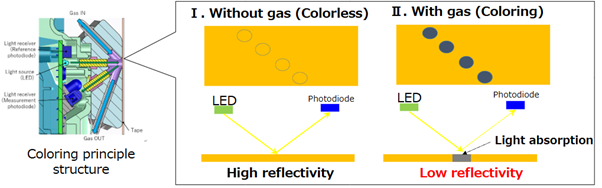
Tape-type gas detectors have a mechanism where the target gas reacts with the reagent, and a visible color appears. The change in absorbance at the discolored section is detected by an emitting and receiving element. The tape is periodically advanced regardless of whether gas is detected, completely eliminating sensitivity degradation due to prolonged gas exposure. The tape is disposable and replaced with a new tape after use. This structure enables tape-type gas detectors to maintain sensitivity even during long-term continuous operation, allowing detection of extremely low gas concentrations.
Since the discoloration remains as visual evidence of gas appearance, this method has been primarily chosen for places like semiconductor factories where toxic gases are frequently used and low-concentration, high-precision monitoring is essential.
Image: detection principle
Widely used tape type gas detectors require significant time for tape replacement and operating cost. The working time of tape replacement and training inevitably impacts labor costs.
Furthermore, common tape type has a shorter life cycle because the reagents inside tend to degrade over time. Since tape types are susceptible to temperature and humidity changes, common tape types require frozen storage and must be returned to room temperature before use.
Gas detectors are essential in precision equipment manufacturing, such as semiconductor production, for compliance with industry standards and guidelines, as well as for employee safety. The man-hours and costs associated with their maintenance should be minimized as much as possible.
Solution By FPM-80A Cassette Tape
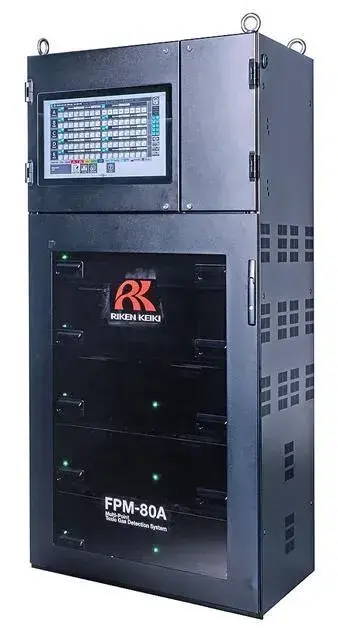
The FPM-80A solves common tape type challenges by adopting long-life cassette-type tapes. Below we introduce the features of the FPM-80A's.
Cassette-type for easy tape replacement
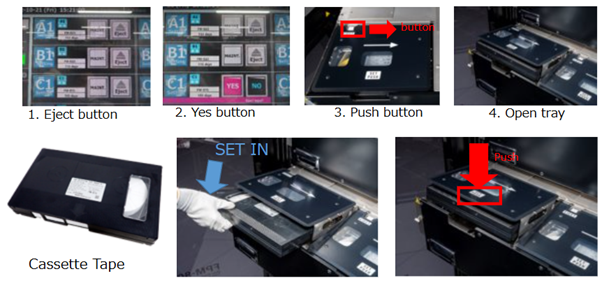
The tape shape in the FPM-80A is imaged by the cassette tapes used for watching VHS videos back to your childhood. We can see clearly how simple and easy replacement is from the diagram below. The tape replacement can be done with one hand and takes about one minute to complete.
Image: Cassette Tape Replacement Procedure
We have been using cassette-type tapes since the first fixed model released in 1995. In 2001, an 8mm (0.3inch) thick microcassette type was developed. The FPM-80A cassette dimensions are 309mm (12.2inch) x 178mm (7inch) x 36 mm (1.4inch).
Cassette-type tapes eliminate any concerns about direct contact with chemicals impregnated in the tape, making sensor maintenance safer and easier. Its robust cover provides protection, minimizing concerns about damage from environmental influences or external impacts. The required functions for measurement tapes were packaged as standard, pursuing ease of use from the user's perspective.
180 Consecutive Days Monitoring
We have conducted over 30 years of research into the measurement techniques used in this product series. In the past, we faced challenges such as reagent volatility and degradation caused by external atmospheres or light. Through repeated research on reagent types, manufacturing processes, and measurement techniques, we have resolved these problems.
The detection tape maintains stability for a long standard usage period of 180 days, enabling continuous monitoring without compromising accuracy. This capability results from our accumulated research over many years.
Stored Refrigerated for up to 6 Months
In recent years, political instability has undermined supply chain stability, and it is natural to want to stockpile consumables in case of emergencies.
We have developed an original tape with a unique agent formulation and structure, enabling storage for up to 6 months - longer than common tapes. Furthermore, while most tapes require freezing, our tape can be stored under refrigerated conditions (below 10°C in a dark place). This eliminates concerns about tape breakage due to freezing, and if properly refrigerated, the tape remains usable for 180 days of continuous detection even after six months of storage.
Long-term storage capability reduces the risk of potential line stoppages. It minimizes the frequency of purchasing tapes and its dead inventories as well as reducing unnecessary maintenance concerns and costs.
RFID: Managing Expiration Dates
This cassette case contains an RFID tag. The reader on the main unit can read this tag, allowing you to check the tape type and remaining tape length on the monitor screen. This enables you to display all information at once without visually checking each tape individually, making it easier to track expiration dates.
Comparative Verification
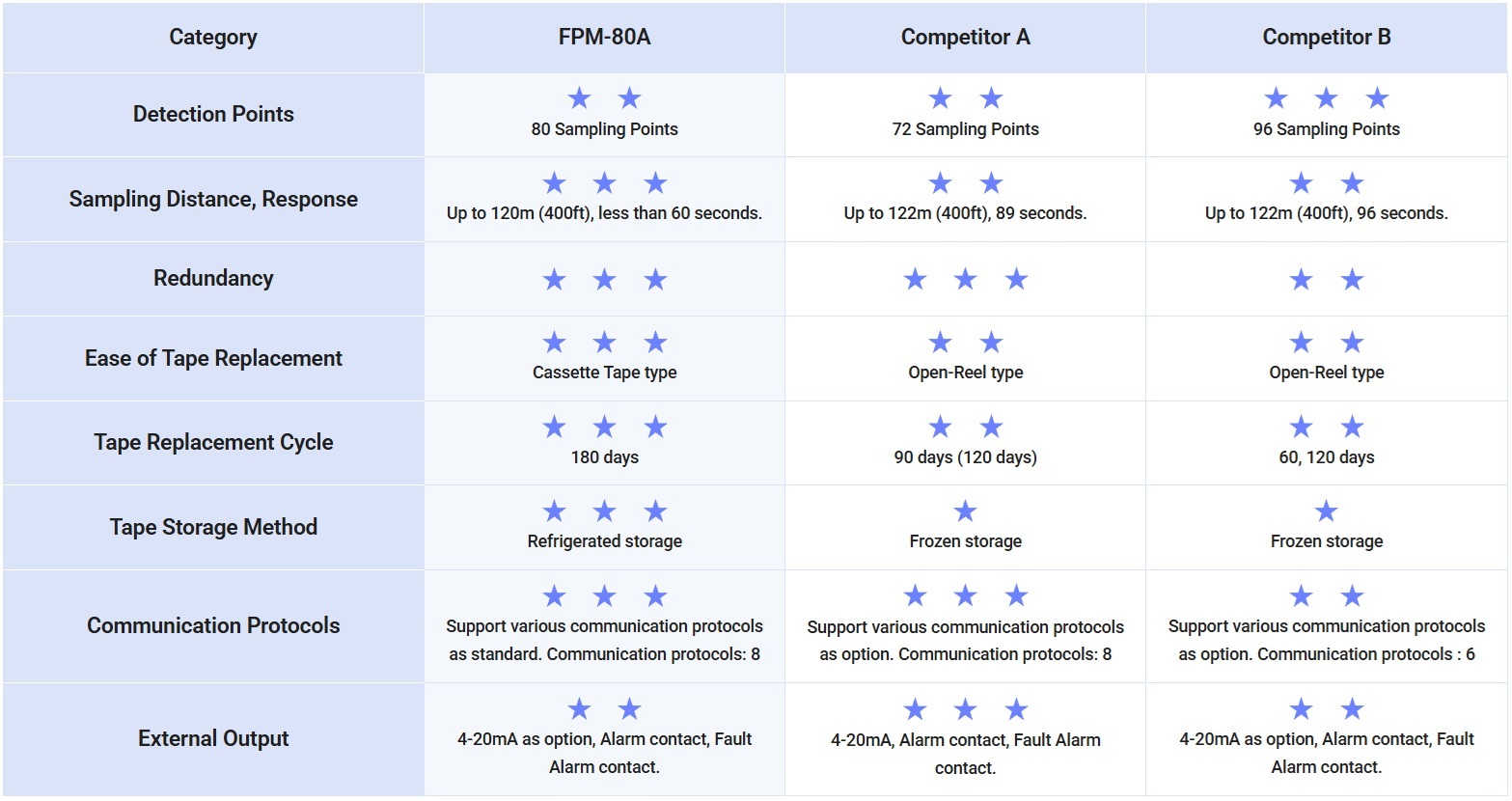
The table below compares the tape performance of the FPM-80A with other existing products. The numerical values and performance information in the table were obtained from other companies' product catalogs by us and other sources as of September 2025.
Table: Comparison with Other Companies' Gas Detectors
For more details, please refer to the white paper.
Regarding tape life cycle, other companies offer 180-day life cycles. In fact, all tape types from other companies do not have a 180-day life cycle. Our FPM-80A tapes are available for detecting various chemical species, including hydride (SiH4, PH3, AsH3, H2S, B2H6), Oxidizer (CL2, F2, CLF3), and Mineral acid (HF, HCL, HBr) compounds. All our tapes guarantee 180 days of continuous monitoring compared with others.
Another remark we would like you to pay particular attention to is the cost.
The FPM-80A offers significant cost advantages in both the main unit price and the consumable tape. The main unit is priced over 20% lower than competing products. Furthermore, the cost per measurement point based on tape price and shelf life is over 4% cheaper than competing products.
We hope this information will assist you in selecting the right devices for your business development.
Conclusion
The tape used in gas detectors is a consumable item, and it is desirable to minimize both its cost and the labor involved in replacement as much as possible. Our company introduced cassette tape 30 years ago and has pursued ease of replacement. The cassette case protects the tape from external impacts and atmospheric degradation, while preventing physical contact between the reagent and the workers.
Furthermore, our tapes guarantee continuous monitoring for 180 days for all chemicals while maintaining the required performance reliably.
It can be stored at temperatures below 10 degrees Celsius and has a long shelf cycle of six months, reducing the risk of gas detectors stopping and contributing to long-term cost savings.
For any questions regarding FPM-80A tape or product specifications, please feel free to contact us below.
Inquire About FPM-80A
This article is mainly about the convenience of gas detector tapes, but for other outstanding features of the FPM-80A such as high reliability through redundancy and ease of use via remote control, please refer to the following article.
PRODUCTS
Product type |
Fixed Gas Detector |
|---|---|
Applications |
|
single/multi |
Multi |
Want to hear from an expert?
You may also be
interested in
Why Redundancy is the Lifeline of Semiconductor Manufacturing? The “Dual-Backup” That Prevents Production Stop During Equipment Failures.
Discover how redundancy in semiconductor manufacturing, particularly through the FPM-80A gas detector, ensures continuous operation and mitigates costly production stops.
The Evolution of Gas Detection Tape: 180 Days of Maintenance-Free Operation
Discover how the FPM-80A gas detection tape offers 180 days of maintenance-free operation, enhancing safety and reducing costs in semiconductor manufacturing.
Publications