Organometal Halide Perovskites as Visible-Light Sensitizers for Photovoltaic Cells.
J. Am. Chem. Soc. 2009, 131, 6050–6051.
Kojima, A.; Teshima, K.; Shirai, Y.; Miyasaka, T.The AC Series provides highly sensitive, simple, and fast measurement of ionization potentials, essential for organic semiconductors.


Organic Light Emitting Diodes(OLEDs)

Perovskite Solar Cells (PSCs)

Organic Field-Effect Transistor (OFETs)
Organic Photodiodes (OPDs)

Organic Solar Cells
(OSCs)
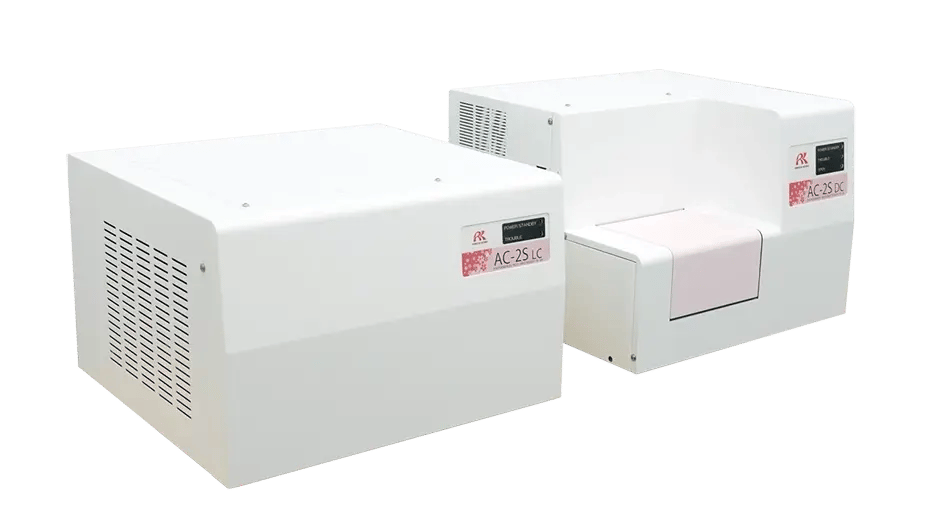
The AC Series is a Photoelectron Yield Spectroscopy system operated in air (PYSA), based on an open counter capable of detecting and counting photoelectrons under atmospheric conditions. This open counter was invented by Dr. Masayuki Uda during his tenure at RIKEN (The Institute of Physical and Chemical Research).The AC Series enables the measurement of work function, ionization potential, film thickness, surface contamination, and monolayer adsorption.

In the organic electronics device industry, including OLEDs and Perovskite Solar Cells, ionization potential measurement is crucial for both R&D and production. Work function and Ionization potential allow estimation of the HOMO energy of metals and organic materials, which determines charge transfer between materials that make up organic electronics devices. However, depending on the measurement device, ionization potential analysis has faced several challenges: samples often need to be introduced into a vacuum chamber, measurements can be time‑consuming, trained operators may be required, strong UV irradiation can risk degrading the samples, and both the initial investment and running costs tend to be high.
The AC Series offers solutions.

Easily measured in air in about 5 minutes.

Minimized sample damage ensures high reproducibility and repeatability.

Short measurement time, and low initial/operating costs.
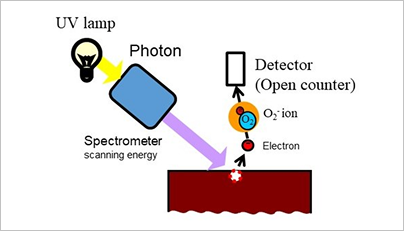
The AC Series is a surface analysis instrument that illuminates a sample with ultraviolet light, detects and counts photoelectrons emitted via the photoelectric effect using an open counter, and enables rapid and simple determination of ionization potentials and work functions in ambient air.
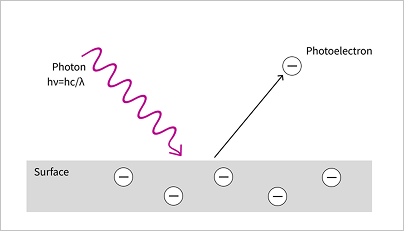
Ultraviolet light from a UV lamp is dispersed by a grating spectrometer to produce monochromatic light of wavelength λ (frequency ν). This light irradiates the sample with photon energy E = hν = hc/λ, where h is Planck’s constant and c is the speed of light. As the photon energy increases, photoelectrons are emitted from the sample surface once the energy exceeds a threshold. This threshold is known as the work function for metals and the ionization potential for semiconductors.
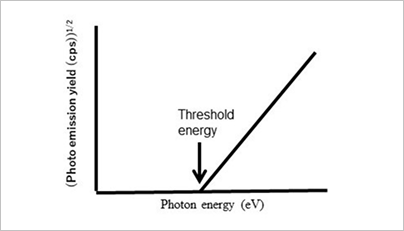
The AC series is a device that counts photoelectrons. We consider the photoelectron yield Y, which is the number of photoelectrons emitted per photon incident on the sample. Given the ionization potential (IP) or work function (φ), it is known that the relationship between the incident light energy hν, φ, and Y is Y^n ∝ (hν - φ). The exponent n is often 1/2 for metals and 1/3 for semiconductors.In other words, by varying the energy of the incident light and counting the photoelectrons, the ionization potential or work function can be calculated. This is the measurement principle of the AC Series.
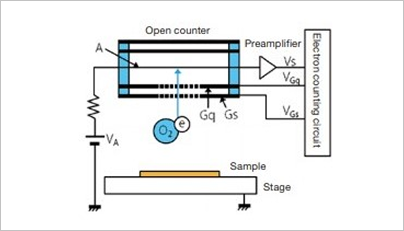
The AC Series employs an open counter capable of counting photoelectrons in air. In this counter, oxygen molecules in the atmosphere act as carriers that transport photoelectrons into the interior of the detector, where they are amplified and detected through electron avalanches. In air, these avalanches do not necessarily self‑quench. Therefore, once an avalanche is detected, the grid voltage is immediately adjusted to terminate it. This method enables the counting of individual photoelectrons.
The AC Series is a long-standing instrument that has been manufactured and sold by Riken Keiki Co., Ltd. since 1986. It is widely used to measure ionization potentials and work functions in research and manufacturing environments, including applications such as organic EL and perovskite solar cells. As of September 2024, it has been cited in more than 1,600 scientific papers.
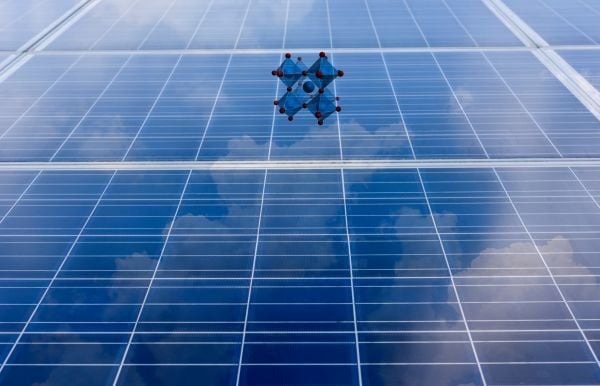
J. Am. Chem. Soc. 2009, 131, 6050–6051.
Kojima, A.; Teshima, K.; Shirai, Y.; Miyasaka, T.
Appl. Phys. Lett. 1995, 67, 2281–2283.
Kido, J.; Shionoya, H.; Nagai, K.
Appl. Phys. Lett. 1995, 66, 2679–2681.
Adachi, C.; Nagai, K.; Tamoto, N.
Organic semiconductor materials can show property variations even with slight lot-to-lot differences. By measuring ionization potential and controlling variations in energy levels, the AC Series helps stabilize quality in mass production.

Organic semiconductor materials are easily affected by storage conditions and changes over time. The AC Series measures ionization potential and evaluates degradation based on changes in it, and the resulting measurement data is used for incoming inspection and inventory control.
The properties of organic semiconductor materials vary depending on deposition conditions. By rapidly measuring ionization potential after deposition, the AC Series enables evaluation under conditions close to actual use and supports process optimization.
Easily measured in air in about 5 minutes.
The open counter enables measurements in air while maintaining high sensitivity, allowing samples to be evaluated in their actual operating environment. Because no vacuum system is required, the following advantages are achieved:
• Ionization potential (IP) and work function (Φ) can be easily measured in about 5 minutes, accelerating new material development and enabling quality checks for mass‑produced products.
• Both initial and running costs can be reduced.
Easy Measurement Setup
Fast Measurement and Analysis
Minimized sample damage ensures high reproducibility and repeatability.
The open counter can detect and count individual photoelectrons one by one, providing high sensitivity. This ultra‑sensitive electron measurement enables sufficient data acquisition even under weak UV irradiation, low photoelectron emission, or short measurement times. Because the required UV irradiation and photoemission levels can be kept low, sample damage is minimized. As a result, stable and reproducible results are obtained, making the system suitable for applications such as quality control of mass‑produced products.

Short measurement time, and low initial/operating costs.
Because measurements can be performed in the atmosphere, no vacuum equipment is required, resulting in low initial costs.In addition, atmospheric measurement allows samples to be exchanged quickly, enabling short total measurement times and simplifying operation. Combined with dedicated software that allows anyone to easily perform measurements and analysis, these advantages reduce operating and personnel costs.

In addition to the AC Series, other instruments for measuring ionization potentials and work functions include UPS (ultraviolet photoelectron spectroscopy), which operates under vacuum, and current-mode PYS systems, which detect large numbers of photoelectrons as electric current. Among these, the AC Series stands out for its ability to measure ionization potentials (IP) and work functions (Φ) in air with low sample damage, high reproducibility and repeatability, and simple operation in about 5 minutes, using an open‑counter design that counts individual photoelectrons. This capability enables accelerated research and development and high‑productivity evaluation in fields such as organic light emitting diodes, perovskite solar cells, and quantum‑dot devices.
| Fields | AC Series | UPS | current-mode PYS |
|---|---|---|---|
| Track Records |

|
|
|
| Fast Measurement |
|
|
|
| Sample Damage | small | large | large |
| Photoelectron Sensitivity |
|
|
|
| Low Initial and Operating Costs |
|
|
|
| Simple Measurement Procedure |
|
|
|