Skip to content

Table of Contents

    Fact: “Foreign Object Contamination” at Waste Disposal Facilities

    As awareness of recycling and environmental conservation grows, the importance of intermediate waste treatment facilities continues to increase. However, there is one issue that constantly threatens safety and health personnel on-site: the risk of fire and explosions during crashes. According to the reports of fires at waste disposal-related facilities are on the rise in North America, and similar risk management challenges are emerging within Japan as well.

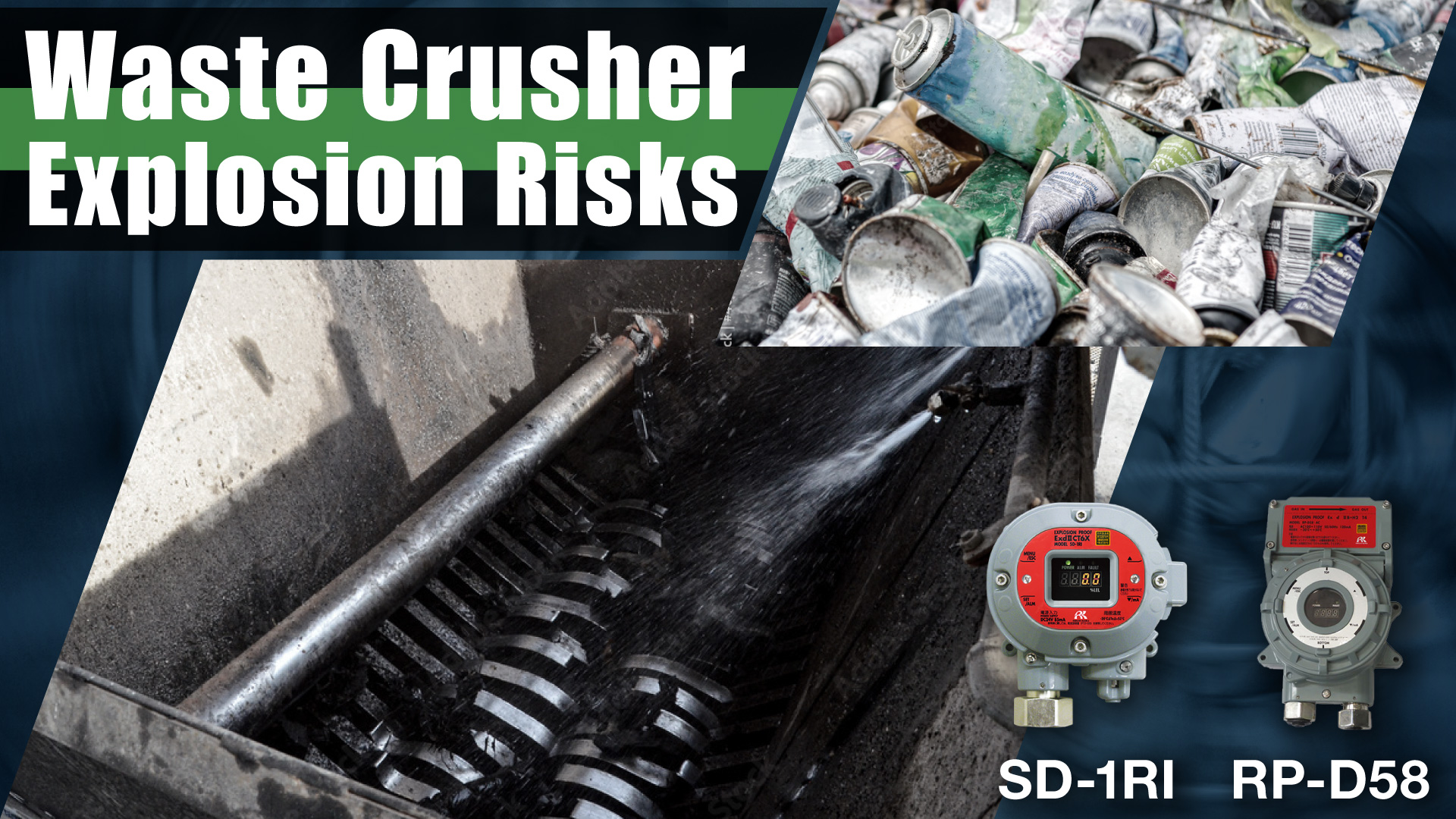
    Crushers are primarily designed to finely crush metal and non-combustible waste. However, situations of mixed waste of unsorting spray cans such as cassette gas cylinder, hair spray can, paint can, and aerosol can with regular waste continue to occur frequently. It is difficult for all citizens to sort waste perfectly, and manually removing only the hazardous cans from vast amounts of garbage is not practical. Therefore, we need to understand the countermeasures based on the premise that “hazardous items may be mixed in”.

    Why Do Explosions Occur? The Dangerous Mechanism Inside Crushers

    Explosions inside crushers primarily occur through the following three processes: 

    • Gas Release and Accumulation:
      When spray cans fed into the crushers are cut by powerful blades, the LPG (Liquefied Petroleum Gas) and flammable solvents inside are released all at once

      Due to the machine's structure, the inside tends to become semi-sealed environment, because of gases heavier than air, it accumulates toward the bottom.

    • Ignition Source:
      When crushing metal waste, intense friction and impact between metal pieces constantly generate flying sparks.

    • Ignition and Explosion:
      If a spark occurs at the moment the concentration of accumulated gas exceeds the explosion hazard threshold (Lower Explosive Limit (LEL)), ignition occurs, leading to an explosion.

    For details on flammable gases and explosion mechanisms, please refer to this link.

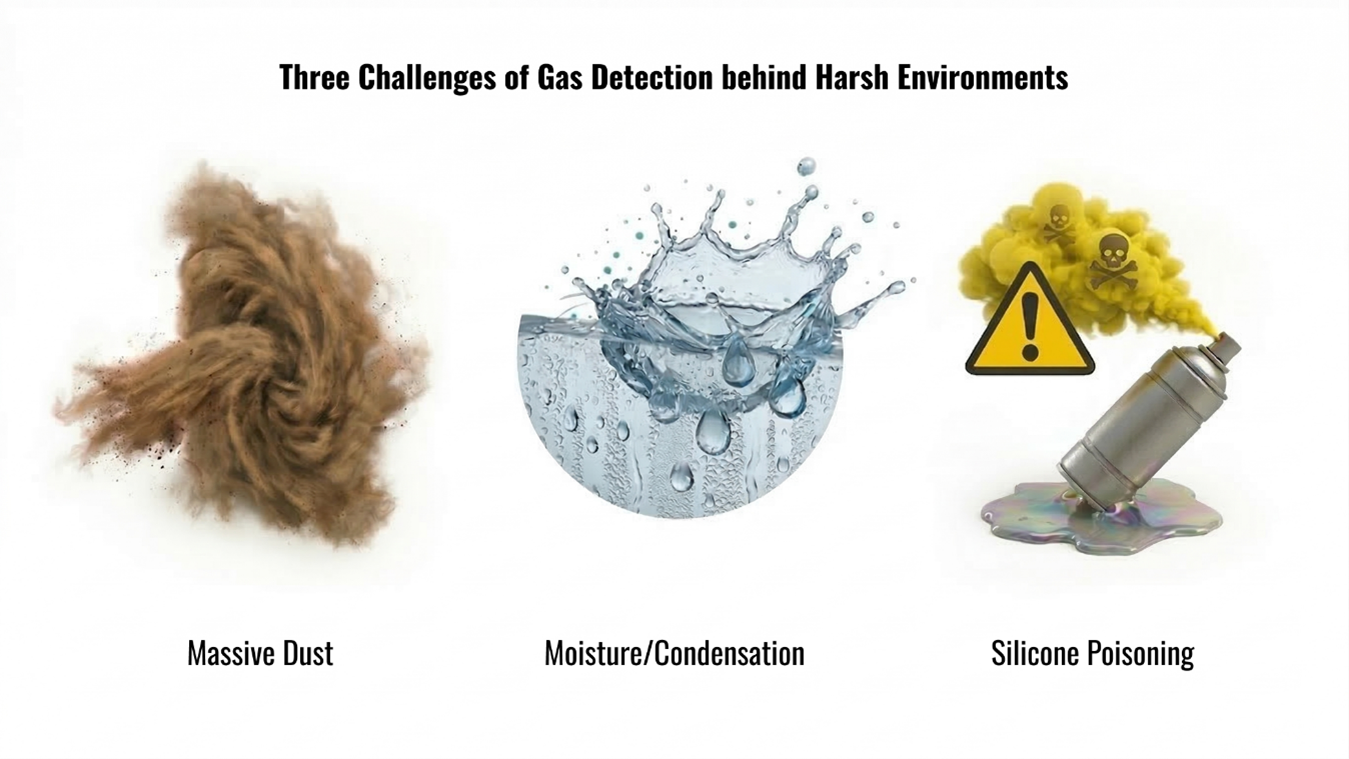
    Three Challenges of Gas Detection behind Harsh Environments

    “If gas can be detected as soon as it accumulates, explosions can be prevented.” Theoretically, yes - but implementation on-site is far from simple. Three major obstacles stand below:

    • Massive Dust:
      When crushing waste, an enormous amount of dust is generated, instantly it clogs sensors and suction pipes.

    • Moisture/Condensation:
      Thorough sorting processes, moisture in the waste itself is less; the real risk of sucking moisture in condensation in pipes within the facility is not zero percent.
      If moisture enters the sensors inside, it could cause equipment failure or prevent accurate detection.

    • Silicone Poisoning:
      Cosmetics and shine sprays contain “silicone.” Once widely used contact combustion-type gas sensors (catalytic combustion type), as its sensing principle, are generally susceptible to be poisoned by silicone compounds, it causes loss of sensitivity by coating the catalyst surface. This is called “silicon poisoning,” leading to the most terrifying scenario: “gas is present, the alarm does not go off.”

    0001

    The Technology of the “Gas Sampling Panels” for Reliable Detection

    Of these three challenges, “Silicon Poisoning” can be overcome by adopting an “Infrared (NDIR: Non-Dispersive Infrared Absorption)” detector unaffected by silicon. However, the remaining issues of ‘dust’ and “moisture” cannot be fully prevented by high-performance detectors alone.

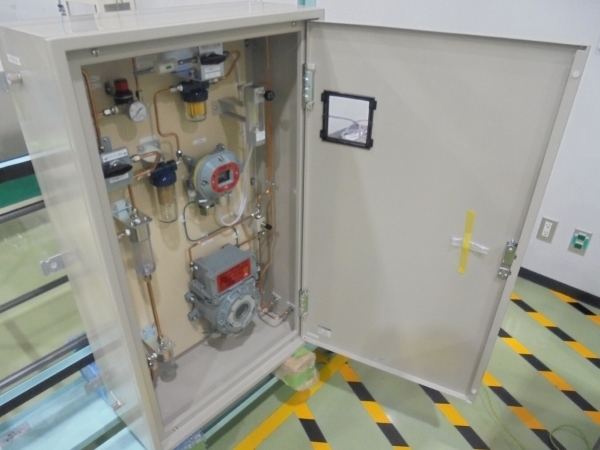
    Then the construction of a pre-treatment system, the “Gas Sampling Panels”, becomes crucial. This system removes impurities before the gas reaches the detector.

    Countermeasures Against Dust:
    A coarse filter called a “Strainer” is installed inside the crusher, immediately adjacent to the sampling point for gas intake. However, it quickly becomes clogged with large amounts of dust. Therefore, a “Back Purging Function” that reverses the flow of compressed air through the piping is incorporated into the system.

    By periodically injecting air to physically blow away the dust adhering to the strainer, the suction flow path is secured.

    Moisture Control:
    The aspirated gas may contain significant moisture. By incorporating an automatic drain device such as a “separator pot” or “drain pot” within the panel, moisture is reliably removed, ensuring only moisture-free gas is delivered to the detector.

    Benefits of Using a “Panel”:
    Installing these pumps, filters, detectors, and other equipment separately on walls creates complex piping, increasing installation labor and maintenance difficulty.

    Riken Keiki offers “Turn Key” system that packages all these components into a single “panel” functionally. This simplifies on-site installation, provides a clean, manageable appearance, and delivers an optimal gas detection environment.


    Example of the Sampling Panel

    s0002

    Strategy of Prevention Before an Accident (Explosion)

    Implementing continuous monitoring in systems with proper engineering dramatically improves safety management levels.

    For example, if the sensor could detect gas leaks at the point of low concentrations such as 10% LEL or 20% LEL, the system automatically triggers emergency shutdowns (Interlocks) of crushers or activate sprinkler systems.

    Once an explosion occurs, the costs of repairing equipment and damage from operational shutdowns are immense. The critical rule for safeguarding stable infrastructure operation and worker safety is not “extinguishing after an explosion,” but “stopping equipment before explosive conditions are reached 

    Our Solutions

    Riken Keiki provides world-standard gas detection solutions designed to withstand the harsh environments of waste facilities around the world.  

    Product: Smart Type Gas Detector [Model: SD-1DRI]
    This flagship model features an “Infrared-type” sensor unaffected by Silicon Poisoning. Optimized for integration into Gas Sampling Systems, it also meets international explosion-proof standards. 
    For product details, click here. 

    Product: Explosion-Proof Suction Pump [Model: RP-D58]  
    This industrial pump is suitable for use in hazardous locations. It continuously and powerfully extracts gas from inside crushers, even in harsh environments with dust and vibration.  

    Additionally, it features a flow rate reduction sensor, and it can output an external signal (contact) to indicate an abnormality suction power decrease due to pipe blockage or similar issues.
    For product details, click here.

    Gas Sampling Panels Customization
    We develop Gas Sampling Panels tailored to your requirements and circumstances, building optimal gas detection environments in conjunction with gas detectors.

    PRODUCTS

    Fixed Gas Detector
    RP-D58

    Product type

    Accessories & Units

    Applications

    single/multi

    ← →
    inquire_slash

    Want to hear from an expert?

    Our team will be happy to help. Let’s find the right solution for you.

    Publications

    case_img-1
    See how companies across different industries are using our advanced gas detectors to prevent accidents, ensure compliance, and enhance safety. Exclusive case studies inside!
    case_img-1