Hazardous Gas Leak Detection in Inert Atmosphere and Reduction of Management Costs – Case Studies: Safety Measures for Double - Walled LNG Tanks.
Table of Contents
The “Double Safety” Requirement for Large LNG Storage Tanks
Large-scale facilities handling flammable gases or volatile substances widely employ inert purging. While inerting is an effective solution of reducing combustibility, it does not eliminate leaks themselves.
In environments with little or no oxygen, conventional detection methods may be difficult to use. The structure of the monitoring system significantly impacts operational burden and management costs. To address leak monitoring and equipment management within inert environments, this article introduces the gas detection solution we provide, using an LNG tank case study as an example.
LNG (liquefied natural gas) is natural gas cooled to -162°C to turn it into a liquid state. Its volume is reduced to about one six-hundredth of its gaseous state, making it suitable for bulk transport and storage. However, once it leaks, it rapidly vaporizes and poses the risk of forming a flammable gas cloud.
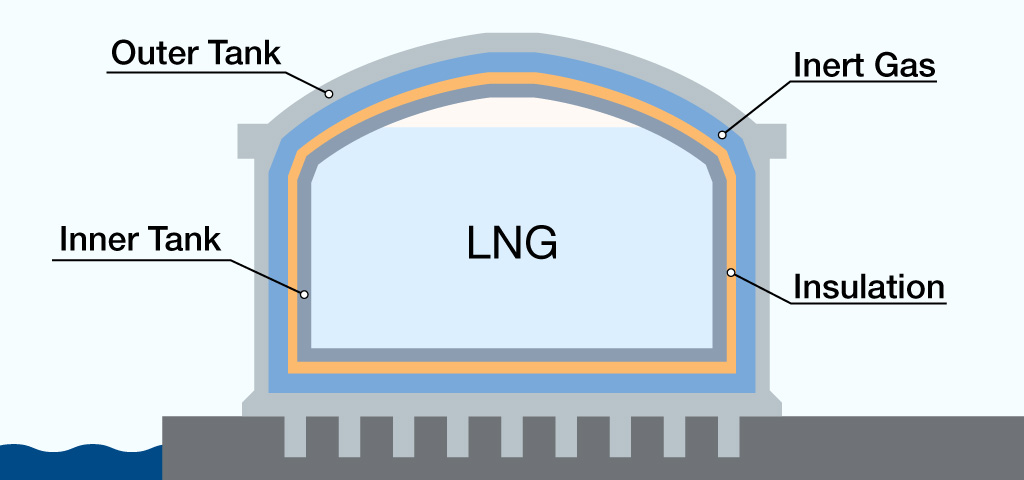
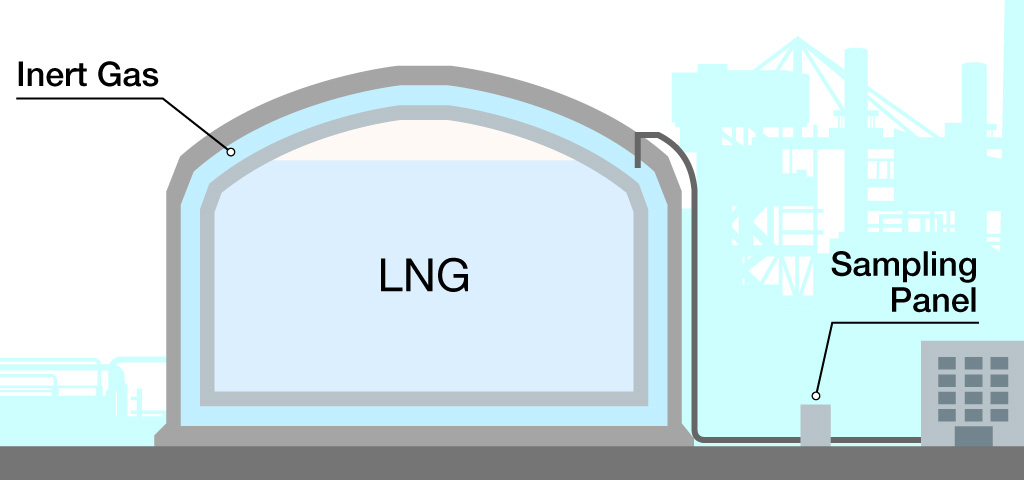
To avoid this risk, large LNG tanks consist of “double-walled structure.”
The inner tank (inner shell) directly holds the LNG, while the outer tank (outer shell) surrounds it. Even if LNG leaks from the inner tank, the outer tank is designed to contain it. and the outer shell acts as a secondary wall.
The outer surface of the inner tank is covered with insulation to prevent heat ingress from the outside. A space between this insulation and the outer tank is filled with dry inert gas (mostly nitrogen).
There are two reasons for this.
The first is to prevent explosions. Combustion requires three elements: a fuel source, oxygen, and an ignition source. Filling the space with inert gas displaces oxygen in which methane gas cannot ignite even if it leaks.
The second reason is to protect the insulation material. If air or gas containing moisture comes into contact with the inner tank wall at -162°C, it immediately freezes. If ice penetrates the insulation, it not only reduces insulation performance but also damages the tank itself. Dry inert gas prevents this situation.
In essence, the safety of large LNG tanks is protected by double mechanism: “containment of LNG leaks through a double-walled structure” and “prevention of explosions and maintenance of insulation performance using inert gas.”
Why can’t conventional gas detectors detect it?
Gas detectors commonly referred to as “contact combustion type” are widely used for detecting LNG gas leaks. This method involves burning the gas over a catalyst and measuring its concentration by its heat. Its simple structure and high reliability have made it the standard detection method across various markets.
However, combustion requires oxygen. As mentioned earlier, large LNG tanks require monitoring of the space filled with inert gas. In environments with almost no oxygen, the gas cannot burn, so contact combustion sensors do not react. No matter how much gas leaks, the sensor reading remains at zero. Therefore, this method cannot be used for monitoring large LNG tanks.
The option of an infrared gas detector
Infrared gas detectors are used to detect LNG gas leaks within the double-walled structure of large LNG tanks. Infrared detectors measure concentration by utilizing the property of hydrocarbons like methane to absorb infrared light at specific wavelengths. Since detection relies on light absorption rather than igniting the gas, it functions reliably even in environments like 100% nitrogen. This method is well-suited for monitoring inside the double-walled structure of large LNG tanks because it is unaffected by the presence or absence of oxygen.
There are other advantages.
Contact combustion-type detectors carry the risk of “poisoning,” where the catalyst degrades due to substances like silicon. Infrared detectors do not use a catalyst, eliminating this concern. They keep stable measurement accuracy over long periods. Furthermore, they are designed to easily detect sensor malfunctions by issuing a fault signal if the light source records an abnormality.
How to Efficiently Monitor Large LNG Tanks
Even after selecting a gas detector, there is another crucial consideration: how to maintain it. Many large LNG tanks are massive structures exceeding 80 meters in diameter and 50 meters in height. If gas detectors are installed at the tank's top or sides, workers must climb to high places for every inspection. Working at heights carries risks. It also consumes significant time and costs. Gas detectors require regular maintenance inspections to maintain accurate detection performance.
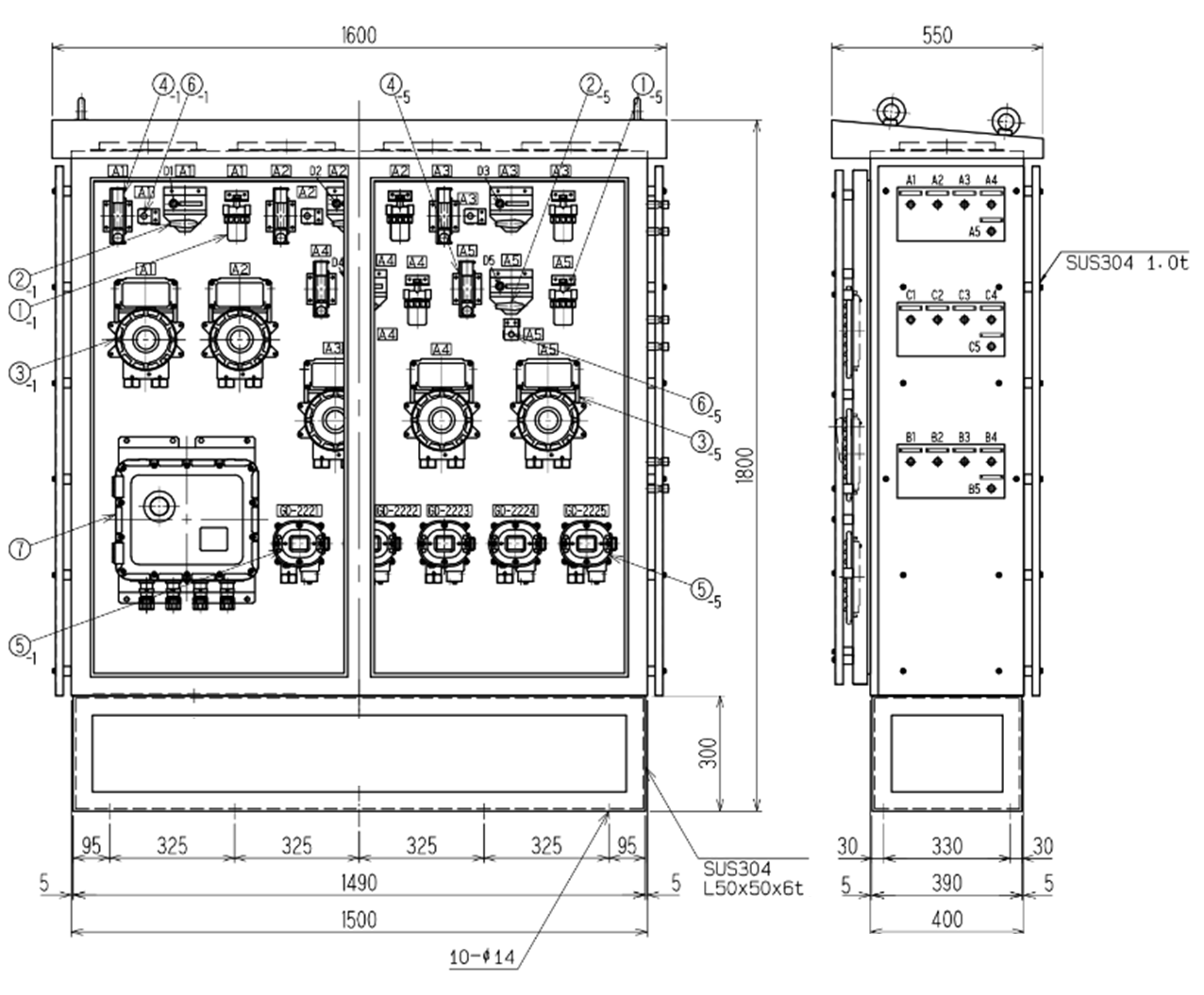
The solution to this problem is the “centralized suction system.” Only intake ports are installed at various points on the tank, and gas is suctioned through these ports via stainless steel tubing and conveyed to the gas detection section consolidated on the sampling cabinet on the ground.
Because the gas detection unit is located on the ground, there is no need to climb to high places for inspections. Calibration and replacement of consumable parts such as filters can be carried out safely at the ground-level sampling applied. Since the tank is outside, protection from direct sunlight and rain is also necessary. The gas detection unit is housed within the sampling plate, and a light shield prevents temperature rise and rainwater ingress. Furthermore, as LNG tanks are often installed near the sea, heavy-duty anti-corrosion coating is covered as a salt damage countermeasure.
Early detection of gas leaks helps reduce LNG spills and prevent explosions. It also contributes to preventing further damage to equipment.
*This is an excerpt from a document.
Our Solution
Riken Keiki provides solutions that enable the “leak detection in inert gas environments” introduced in this article.
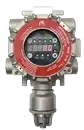
Infrared gas detector SD-1DRI
The SD-1DRI is an infrared gas detector for leak detection in inert gas atmosphere and for reliably detecting methane in oxygen-free environments.
It supports HART communication, enabling the exchange of extensive information such as device status. Furthermore, it has obtained explosion-proof certifications in Japan and in other countries, meeting global safety standards.
High-Performance High-End Model: Infrared Gas Detector SD-3
In addition to the SD-1 series, we offer the next-generation SD-3 model to meet even more advanced requirements.
Compared to the SD-1, the SD-3 offers enhanced functionality and is certified to SIL (Safety Integrity Level), an international functional safety standard.
This objectively ensures extremely safety standards within plant instrumentation systems. Like the SD-1, it holds a wide range of explosion-proof certifications, including ATEX and IECEx, making it ideal for sites demanding higher-level safety management and system integration.
PRODUCTS
Product type |
Fixed Gas Detector |
|---|---|
Applications |
|
single/multi |
Single |
Want to hear from an expert?
You may also be
interested in
Hazardous Gas Leak Detection in Inert Atmosphere and Reduction of Management Costs – Case Studies: Safety Measures for Double - Walled LNG Tanks.
Explore effective hazardous gas leak detection solutions for double-walled LNG tanks, focusing on infrared technology and management cost reduction strategies.
Fire & Gas Devices and Solutions for Oil Operations
Fire & gas safety solutions play a vital role in oil operations, supporting safe extraction and processing of crude oil produced at record levels in 2023.
Silent Poison: A Brief Guide to the Dangers of Benzene in the Workplace
Benzene, a common yet hazardous industrial chemical, poses serious workplace risks.
Publications