
More Efficient Gas Monitoring for Semiconductor Plants with EG-1
Table of Contents
Semiconductor fabrication plants require both an extremely high degree of precision as well as reliable, safety environments, and gas monitoring plays a pivotal role in ensuring both safety and quality assurance during the manufacturing process.
Large factories do, however, often require an extensive number of gas detectors, ranging from the hundreds to even the tens of thousands in certain cases.
While gas detectors play a crucial role in keeping workers safe, managing this many devices requires both a considerable number of PLCs as well as complex wiring work, translating into significant costs for semiconductor plants.
In this article, we will discuss the advantages of our innovative EG-1 solution designed specifically to solve these kinds of issues.
Issue: Managing increasing numbers of gas detectors and their related costs
Semiconductor plants require the installation of extensive numbers of gas detectors to guarantee that any abnormalities or gas leaks are detected immediately, protecting both workers and the production line in the process.
However, the difficulties outlined below often hinder safe and efficient operations.
1. Managing large numbers of gas detectors
Installation of several thousands of gas detectors would typically require the use of numerous PLC (programmable logic controllers) to collect and consolidate data from each of the individual devices.
2. More PLCs means skyrocketing costs and increasingly complex installation environments
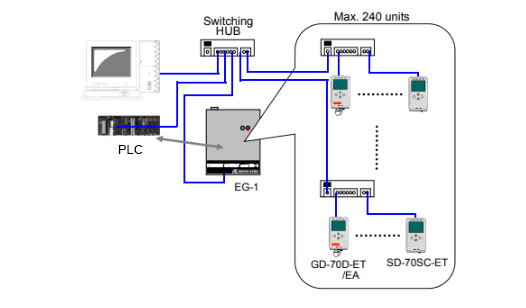
- One PLC is usually required for approximately every 30 gas detectors. For example, to connect 240 gas detectors we would need 8 PLCs.
- More PLCs require increased installation and maintenance costs as well as more space for installation and cables.
These difficulties often get in the way of efficient plant operations, making them some of the more pressing issues faced by today's semiconductor plants, particularly as cost-effectiveness becomes increasingly important.
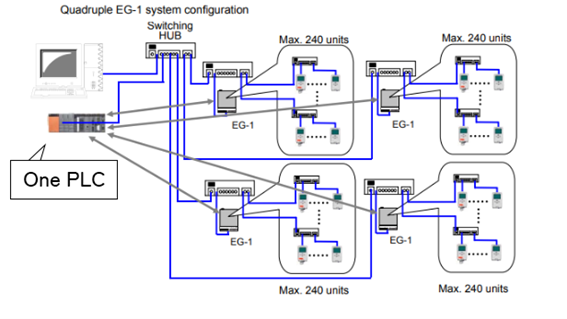
Our Solution: Manage Up to 960 Gas Detectors Using Just One PLC with the EG-1
Application Example 1:Connect Up to 240 Gas Detectors with One Single Device
✓ Fewer PLCs required: Do more with just one single PLC
✓ Lower costs: Cut PLC purchase and installation costs for significant savings
✓ Simplified wiring: No more complicated networks of cables or installation work
Application Example 2: Connect 960 gas detectors in a large-scale facility
What Our Customers Are Saying:
Our facilities have thousands of gas detectors installed, and using the EG-1 has allowed us to cut back dramatically on the number of PLCs we need to use.
In addition to cutting costs, we have also seen improvements in operating efficiency after installing the EG-1.
It has also reduced costs and made expanding the facilities much easier compared to a 4-20mA system.
All in all, we have managed to cut total costs by around 50%, thanks to streamlined installation work and a simpler system overall.
And because the EG-1 uses PoE, it makes expanding facilities much easier because EG-1 devices connected to the network can be supplied with power via LAN cable, eliminating the need for electrical outlets in difficult to install locations.
Benefits of Our EG-1 Solution in Semiconductor Plants
1. Simple to Use, Even in Large-Scale Facilities
2. Fewer PLCs for Improved Efficiency
3. Lower Long-Term Costs
Conclusion: EG-1, the Future of Semiconductor Plants
Safety, efficiency and cost-effectiveness are increasingly important issues faced by today’s semiconductor industry, and more and more companies are beginning to implement our comprehensive EG-1 solution, designed specifically with these issues in mind.
Cut costs and optimize your gas monitoring operations, for more sustainable operations and a competitive edge for years to come, all with our ideal EG-1 solution.
Achieve enhanced safety and efficiency in semiconductor manufacturing with EG-1 from Riken Keiki. Contact us to learn more about what our EG-1 solution can do for your operations.
Want to hear from an expert?
You may also be
interested in
The Importance and Key Considerations of IP Codes When Choosing Gas Detectors
Learn why IP codes matter when choosing gas detectors. Discover how dust and water resistance ensure reliable performance and worker safety in harsh environments.
Heavy Fuel Oil and LNG
Heavy fuel oil powers global shipping with efficiency, affordability, and safety—maximizing cargo space and enabling long-distance voyages.
Gas Monitoring for a More Sustainable Society
Riken Keiki aids sustainability with gas monitors, supporting circular economy efforts and eco-friendly manufacturing practices.
Publications