How to Improve Quality Control Precision in the Mass Production of Organic Semiconductors: Introduction of Direct Energy-Level Evaluation
Table of Contents
The Need for Consistent Quality as Mass Production of Organic Semiconductor Devices Advances
Unlike inorganic semiconductors primarily based on silicon, organic semiconductors are lightweight, flexible, and can be fabricated using low-temperature processes.
Given these properties, efforts toward mass production are beginning to gain momentum not only in fields where mass production is already established, such as organic light-emitting diodes (OLEDs), but also in emerging application areas such as perovskite solar cells and organic transistors.
Once mass production begins, quality control becomes a key management issue in addition to technical superiority; however, a major challenge with organic semiconductors is the variability in their characteristics.
Variability Issues in Mass Production of Organic Semiconductor Materials and Challenges in Quality Control
Organic semiconductor materials are more sensitive to environmental conditions than inorganic materials, with even small differences in material batches or deposition conditions leading to noticeable variations in their characteristics. As a result, characteristics tend to vary even during mass production, and it is essential to conduct batch-by-batch quality verification.
Furthermore, in organic semiconductor devices, the relationship between the energy levels of the materials and electrodes strongly influences device performance. If this relationship is not properly aligned, charge transport is disrupted, leading to a decrease in device efficiency. In OLEDs, this manifests as reduced luminous efficiency and increased power consumption, while in solar cells, it results in reduced power generation efficiency. Ideally, the most rational approach to quality control would be to directly verify these energy levels.
However, in actual production sites, control is primarily based on indirect indicators such as impurity levels and film thickness. Ionization potential, one of the indicators that directly reflects energy levels, traditionally required vacuum-based measurement. Because preparation and measurement took several hours, it was difficult to use on production lines.
For this reason, the inability to directly verify an essential evaluation metric, ionization potential, was one of the factors contributing to the difficulty of controlling organic semiconductor mass production.
The AC Series: Fast Ionization Potential Measurement in Air
As mentioned in the previous chapter, characteristics tend to vary during the mass production of organic semiconductors; therefore, it is important to directly evaluate the energy levels of the materials in order to accurately identify the causes of these fluctuations. One of the key indicators is the ionization potential.
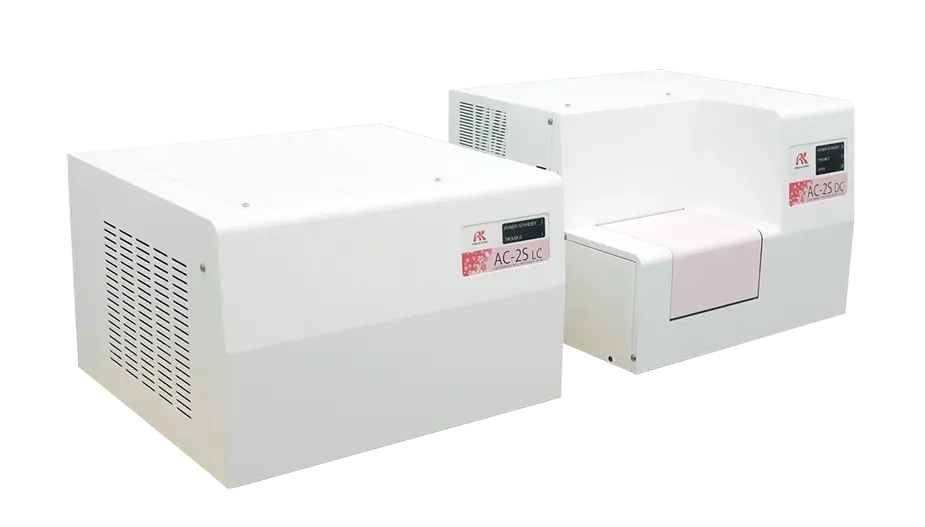
The AC Series enables quality control based on this ionization potential. The AC Series is a Photoelectron Yield Spectroscopy system operated in air (PYSA) that utilizes an open counter invented by Dr. Masayuki Uda during his tenure at RIKEN and that counts photoelectrons under atmospheric conditions. It offers the following features:
-
Easy measurement in air in about 5 minutes: Since no vacuum is required, ionization potential can be measured easily in just 5 minutes, enabling rapid quality checks in mass production.
-
Reduced initial and operating costs: The unit price is lower than that of other measuring instruments, reducing initial costs. Additionally, since measurements can be taken in air, vacuum equipment and pumping are unnecessary, reducing operating costs. In short, this reduces the total costs of equipment, operation, and personnel.
-
Simple measurement and analysis: With simple operation, anyone can perform measurements and analysis. This helps keep training costs down.
Furthermore, the AC Series has a proven track record in research and development at universities, research institutes, and companies, and has been featured in over 1,600 academic papers to date. It has also been used in research on perovskite solar cells and organic EL materials, establishing the AC Series as a reliable method for organic semiconductors. In production processes, it has been adopted by many factories for inspecting batch-to-batch variations and storage degradation in OLED materials, as well as for film deposition inspection.
Another key feature of the AC Series is that the same measurement method can be used in both R&D and mass production processes, allowing data obtained from fundamental evaluations to be directly transferred to the production side.
Click here for blog posts and white papers comparing the AC Series with other ionization potential measurement methods:

Summary
The AC Series enables fast measurement of an ionization potential in air. Unlike conventional quality control methods relying on indirect indicators such as impurity analysis or film thickness measurement, this system allows for direct verification of the relationship between the energy levels of the electrode and the material.
This makes it possible to more directly assess the impact of variations in material batches and film deposition conditions on device characteristics, thereby contributing to improved accuracy in quality control for organic semiconductor manufacturing processes.
PRODUCTS
Product type |
Surface Analyzer |
|---|---|
Applications |
|
single/multi |
Want to hear from an expert?
You may also be
interested in
How to Improve Quality Control Precision in the Mass Production of Organic Semiconductors: Introduction of Direct Energy-Level Evaluation
Gas detection systems prevent explosions in waste facility crushers by detecting combustible gases, ensuring worker safety, and maintaining operational stability through advanced technology and preventive strategies.
Publications